
San Francisco County Court Records After Arrest
San Francisco criminal cases are handled by the Superior Court of California, County of San Francisco Criminal Division. The jail and court systems overlap, but they do not publish the same record. The San Francisco County jail roster shows current custody, booking, bond, next court date, court department, and charge fields. The court record tracks the formal case once the District Attorney files a complaint, the judge sets hearings, and the clerk enters minutes, dispositions, warrants, or other case activity.
For custody and booking detail, use San Francisco County jail inmate records. For booking photo questions, use the San Francisco County jail mugshots page. Court records after a jail arrest should be read with that split in mind. A roster charge may be a booking charge. A court charge is the charge actually filed or later amended in the Superior Court case.
The San Francisco Superior Court case information page is the main online starting point for court records after arrest. The captured page below shows the court's online-service hub, including criminal case information links rather than jail custody fields.
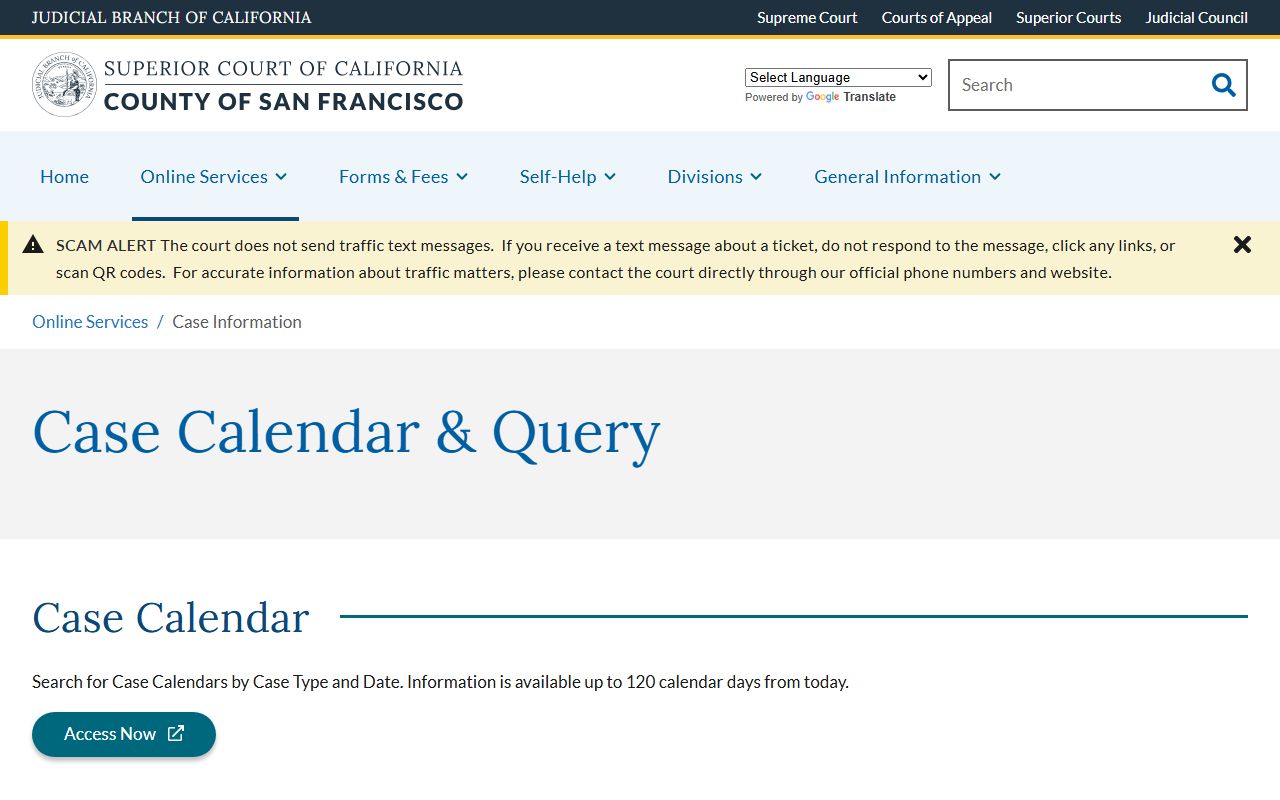
That court hub is useful after charges are filed, while SFSO remains the source for current jail location and intake or release questions.
Search San Francisco County Court Records
The court's online case information page links to three criminal tools: Case Calendar, Criminal Case Query, and Cumulative Criminal Index. The research found that these tools are public but CAPTCHA-gated. The court page says the Criminal Case Query can be searched by case number, defendant name, or attorney name. The calendar can be searched by case type and date or date range, with calendar information available up to 120 calendar days from the current date. The cumulative criminal index is updated weekly.
- Start at the Superior Court case information page and choose the criminal case query or calendar link.
- Search by defendant name when no case number is known, or use the case number from jail, bond, or court paperwork.
- Review the case status, chronological entries, hearing dates, court department, and listed charges.
- Use the Criminal Records Request Form when the online entry does not provide the needed copy or certification.
Remote online access is not the same as full courthouse access. California Rules of Court rule 2.503 limits remote public access to many criminal records. That is why San Francisco County court records after a jail arrest may require the clerk, a request form, or in-person access even when the case can be found online.
San Francisco Court Lookup Channels
The court's channel set is broader than one search box. Each option answers a different question about court records after arrest. The jail roster can point to the next court date and department, but it does not replace the clerk's record. The Criminal Division also directs jail and inmate questions back to SFSO, including the public jail information line and the San Bruno jail number for people housed there.
| Portal or Channel | Search Inputs | Access Notes |
|---|---|---|
| Case Calendar | Case type and date or date range | Court page says calendar data is available up to 120 calendar days from today. |
| Criminal Case Query | Case number, defendant name, attorney name | CAPTCHA-gated public query with case entries and status, not full downloadable criminal files. |
| Cumulative Criminal Index | Criminal index search | Court says records are updated weekly. |
| Criminal Records Request Form | Defendant name, alias, case number, citation number, search warrant number, date of arrest, DOB, and requester contact data | Used for plain or certified copies, complaints, dispositions, abstracts, minutes, and other court records. |
San Francisco County Arrest Charges
The San Francisco District Attorney explains that police investigate and submit a report or warrant request. An Assistant District Attorney then reviews whether there is enough admissible evidence to file charges or seek a DA arrest warrant. If charges are filed, the complaint starts the criminal case. Arraignment follows, where the defendant is told the charges, receives the complaint, enters a plea, and the judge considers release, bail, electronic monitoring, and protective orders.
| Document | What It Does | San Francisco Court Context |
|---|---|---|
| Complaint | Starts the criminal case after prosecutor review. | The DA describes complaint filing before arraignment for misdemeanor and felony pathways. |
| Information | Felony charging document after a preliminary hearing. | The DA lists arraignment on information after the preliminary hearing in felony cases. |
| Indictment | Grand-jury charging document. | SFSO Central Records and Warrants processes grand jury indictments in local warrant and records work. |
San Francisco Charge Status
Court records after arrest can change as a case moves through arraignment, pretrial conference, preliminary hearing, motions, trial, sentencing, or dismissal. A booking charge in a San Francisco County inmate record may differ from the charge the District Attorney files. A filed charge may later be amended, reduced, dismissed, or resolved by plea or verdict. That is why roster data, court data, and final disposition should not be treated as the same thing.
| Status | What It Means |
|---|---|
| Pending | The charge or case is still open and has not reached final disposition. |
| Amended or Reduced | The filed charge changed after prosecutor action, plea talks, motion practice, or court order. |
| Dismissed | The charge or case was dropped by the court or prosecutor before conviction. |
| Convicted | The charge ended in a guilty plea, no-contest plea treated as conviction, or verdict. |
| Warrant or Hold | A missed hearing, separate case, or agency request may keep the person in custody or bring the person back to court. |
San Francisco Criminal Records Request
The Superior Court Criminal Clerk is at 850 Bryant Street, Room 101, San Francisco, CA 94103. The clerk phone listed in the research is 415-551-0651, with public hours Monday through Friday, 8:30 a.m. to 4 p.m., closed from 12 p.m. to 1 p.m. Mail records requests to San Francisco Superior Court, 850 Bryant Street, Room 101, ATTN: Records Clerk, San Francisco, CA 94103. The court form says to submit one request per court number and to obtain a RAP sheet from the SFPD Identification Bureau first if no case number is known.
| Item | Amount or Instruction |
|---|---|
| Certification | $40 |
| Copies | $0.50 per page |
| Standard warehouse retrieval | $6 |
| Search longer than 10 minutes | $15 under Government Code 70627(c) |
| Mailed request payment | Check payable to San Francisco Superior Court with memo "NOT TO EXCEED $50"; postage added if mailed. |
Bond After San Francisco Arrest
San Francisco jail results can show Total Bond, but a bond number alone does not prove that release will occur. At arraignment, the judge may consider detention, release, monetary bail, own-recognizance release, electronic monitoring, or protective and stay-away orders. SFSO annual material also says Central Records and Warrants processes release paperwork and bail, and it checks warrants and holds before release. Research did not locate an official SFSO public page with detailed bail-posting payment methods, bail-window hours, or bail fees.
| Release Term | Meaning |
|---|---|
| Cash bail | Money paid to secure release and court appearance. |
| Surety bond | A licensed bail agent posts bond and charges a premium. |
| Own recognizance | Release based on a promise to appear and court conditions, without money bail. |
| Electronic monitoring | A court-supervised release option; SFSO resumed Pretrial Electronic Monitoring after Simon v. City and County of San Francisco. |
| No-bond hold | A court hold, warrant, detainer, or non-bailable status may block release. |
San Francisco Arrest Warrants
No official public online active-warrant search portal was located for San Francisco County. The local warrant route is the Sheriff's Central Warrant Bureau or Central Records and Warrants Unit. SFSO annual material says that unit processes San Francisco County criminal records and warrants, court commitments, release paperwork, bail, and warrant entries from Superior Court, the District Attorney, juvenile matters, grand jury indictments, civil body attachments, and the Sheriff's Work Alternative Program.
Older SFSO FAQ material says the Central Warrant Bureau can perform a warrant check after a missed court date. For a citable misdemeanor warrant, the bureau can issue a citation with a future court date. For a felony or a non-cite-eligible misdemeanor warrant, the person will be arrested and booked into San Francisco County Jail. A court-date or case-file question belongs with the Criminal Clerk; an active custody question belongs with SFSO. Traffic warrant details have separate limits in the SFSO FAQ and should not be merged with criminal jail warrant handling.
Charges and Convictions
A charge is an accusation filed in court. A conviction is an outcome, usually after a plea or verdict. San Francisco County court records after a jail arrest may show charges long before any conviction exists. Public users should avoid treating the arrest, the booking charge, the complaint, and the final disposition as one fixed record.
| Charge | Conviction | |
|---|---|---|
| Stage | Filed accusation in the case. | Final result after plea or verdict. |
| Proof | Not proof that the person committed the crime. | Reflects a court-recognized guilt finding or plea. |
| Where It Appears | Complaint, information, indictment, minutes, and case query entries. | Disposition records, sentencing minutes, abstracts, or other final court entries. |
Sealed San Francisco Arrest Records
California Penal Code 851.91 provides a process for qualifying arrests that did not result in conviction to be sealed. Sealing limits public access, but it is not the same as physically destroying every record. The court, law enforcement, and authorized entities may still have access in situations allowed by law. California Penal Code 13300 also restricts dissemination of local summary criminal history, with the subject of the record among authorized recipients.
| Sealed | Expunged or Dismissed Relief | |
|---|---|---|
| Public View | Access is limited under the sealing order or statute. | The case may still appear in some court-history contexts depending on the relief granted. |
| Record Holder | The court or agency keeps records subject to access limits. | The court changes the public status or disposition according to California procedure. |
| Best Route | Use the court process or legal counsel for eligibility and filing. | Confirm the exact remedy with the court because California terminology is specific. |
San Francisco Court Access Limits
California's Public Records Act applies to local agencies, including sheriff and prosecutor records, but it does not make every criminal case file fully remote or every investigative record public. Government Code 7923.610 requires specified arrest information to be disclosed unless safety or investigation exceptions apply. Government Code 7923.600 covers investigatory and correctional law-enforcement files and is a key exemption.
The San Francisco District Attorney also has its own public-records process, while SFSO uses its public-records page and GovQA portal for sheriff records. For current custody, use the SFSO roster, jail information line 415-553-1430, Intake and Release 415-558-4443, or the 425 7th Street lobby. For state prison custody, use CDCR CIRIS. For federal prisoners, use BOP. For immigration detainees, use ICE ODLS. For custody notifications, use VINELink. No active San Francisco sheriff or police custody app was located.
Important: Court and jail records are not consumer reports and should not be used for employment, credit, housing, insurance, or similar FCRA-covered decisions.