
Intake and Release Center Overview
The Intake and Release Center, also identified in SFSO annual-report material as County Jail #1, is the point where people arrested in San Francisco are booked into the Sheriff's Office jail system. SFSO states that it books people after arrest at this location and either releases them or transfers them to county jail housing. That makes the facility central to the first hours after an arrest, but it is different from County Jail #2 and County Jail #3, which are housing facilities with regular visiting schedules.
Public users should treat the Intake and Release Center as the place for release pickup, immediate booking questions, and in-person fallback, not as a place to schedule a social visit. The research is explicit that visits are not allowed at the Intake and Release Center. If a person is held after intake, the public roster should identify the current jail location when it is available. If the person is released, moved, or not yet visible online, the direct line and after-hours line are the next practical steps.
SFSO's official Intake and Release Center page is the source for the booking and release function and matches the facility's public role.
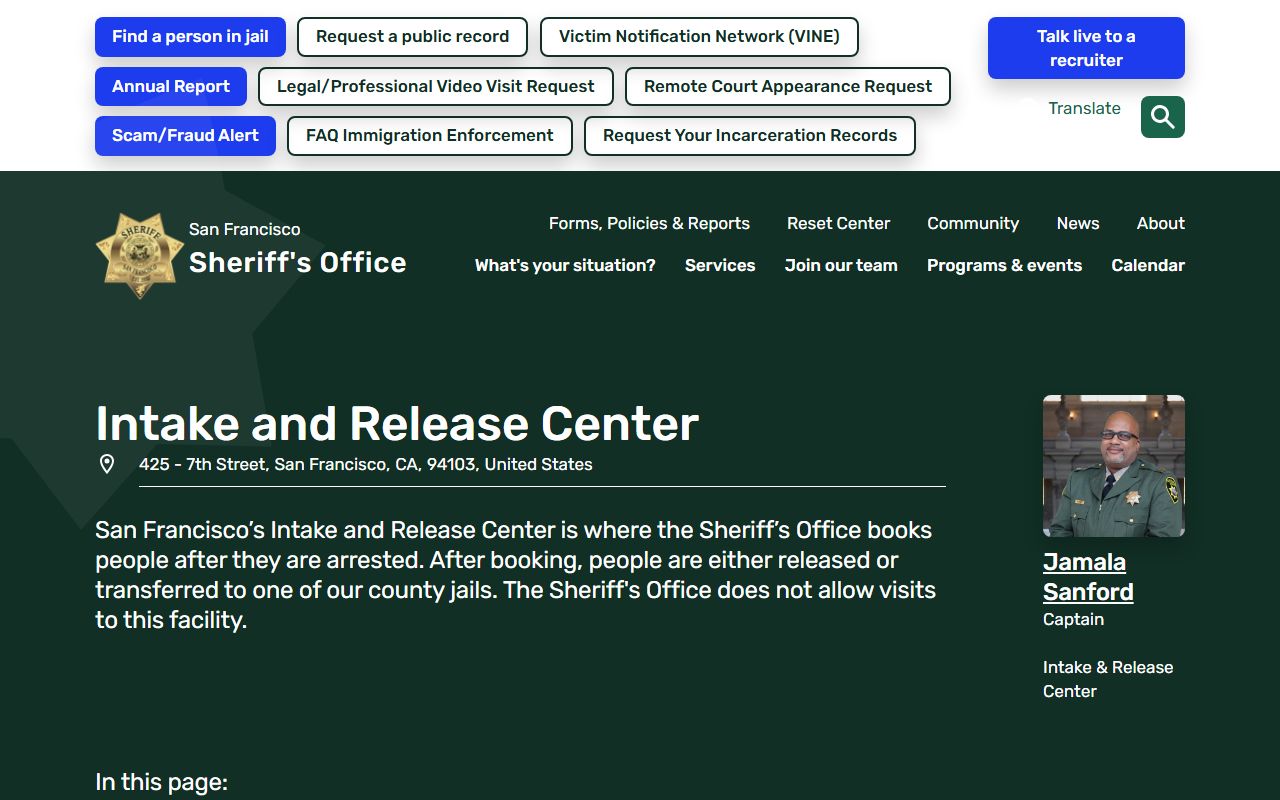
The page should not be confused with the SFSO visiting page because public visits are not conducted at this processing facility.
Intake Capacity and Population
The 2025 SFSO annual report lists County Jail #1, Intake and Release, at 425 7th Street with an opened date of 1994, capacity of 298, and average jail population of 33. That lower average population reflects the facility's processing role. People do not normally remain at intake as a long-term housing assignment. They may be released, transferred to County Jail #2, transferred to County Jail #3, moved to the Annex when appropriate, taken to a hospital custody unit for medical or psychiatric care, or transferred to another custody system by court order or agency action.
The number matters because intake is part of the San Francisco County inmate population even when it does not work like a regular housing jail. A person may be in the booking process before the public has enough detail to plan a visit or deposit. Booking is the jail intake event after arrest. Release processing is the step when bail, court release, sentence credits, transfer status, warrants, or other legal holds are reviewed before the person leaves custody.
Search Intake Custody
Use the SFSO Find a Person in Jail page for current San Francisco jail custody connected to the Intake and Release Center. The search has three paths: first and last name, SF number, or booking number. SFSO says to enter the first three letters of the first and last name. The app also supports a permanent SFNO and an exact booking number. A result can show the person's current location, booking number, total bond, next court date, court department, charge statute, charge description, and scheduled release date when set.
New arrests are the place where the fallback chain matters most. A person may be in intake, released, or transferred before family members have a booking number. If the SFSO roster has no result, SFSO's own visiting page says that means the person is not in the San Francisco jail system. That statement is limited to SFSO custody. It does not rule out CDCR, BOP, ICE, another county, hospital treatment, citation release, or a later booking update.
- Search the SFSO jail roster by name, SF number, or exact booking number.
- Check whether the result shows a current facility or a release-related status field.
- Call the Intake and Release Center for booking or pickup questions when the arrest is recent.
- Use the after-hours line on weekends, holidays, or outside business hours.
- Use GovQA records, VINELink, CDCR, BOP, or ICE if the person is not in San Francisco jail custody.
Intake Address and Contact
The Intake and Release Center is at the same 7th Street jail complex as County Jail #2. That can lead to wrong assumptions about visiting. Ask direct questions about booking, release pickup, transfer, or property, and use the person's SF number or booking number when available. For broader roster field meanings and alternate systems, the San Francisco County inmate records page covers county, state, federal, immigration, and notification channels.
Intake and Release Center
425 7th Street
San Francisco, CA 94103
415-558-4443
Booking, intake, release, and transfer processing; after hours, weekends, and holidays 415-553-1444.
County Jail #2 Main Line
425 7th Street
San Francisco, CA 94103
415-554-7225
Use when the person has been housed at County Jail #2 after intake.
No Intake Public Visits
SFSO states that visits are not allowed at the Intake and Release Center. That rule is important because the center is a custody processing location, not a standard housing unit with a public visiting calendar. If a person remains in custody after booking, use the roster to confirm whether the person has moved to County Jail #2, County Jail #3, or another San Francisco custody location. Public social visits are then governed by the housing facility's schedule and by the SFSO jail visiting information page.
The same SFSO visiting rules apply once a person is moved to a housing facility: schedule through GTL, arrive 30 minutes early, bring current government-issued photo ID, and follow locker, dress, and conduct rules. The 2026 SFSO notice suspending weekday in-person visiting at County Jail #2 and County Jail #3 from April 20 through June 30 does not create intake visits. It only affects the housing facility calendar.
| Location | Public visit rule | What to do instead |
|---|---|---|
| Intake and Release Center | No public visits allowed | Use for release pickup and booking questions. |
| County Jail #2 | Visits by pod schedule | Confirm the roster location and schedule through GTL. |
| County Jail #3 | Visits by San Bruno schedule | Confirm current location and allow time for gate or shuttle access. |
Note: Do not travel to intake for a social visit; confirm housing first through SFSO.
Intake Mail and Money
Mail and commissary are most useful after a person has been housed at County Jail #2 or County Jail #3. For intake-only processing, the person may be released or transferred before mail can be delivered. SFSO mail rules say mail is delivered only to the named currently incarcerated person, forwarded unopened if the person moves to another jail or prison, or returned if the person has been released. That rule is why the roster location and SF number should be checked before sending mail.
The SFSO mail and commissary page requires U.S. Postal Service mail and gives facility-specific address formats. The deposit page lists the 425 7th Street money window, a 24-hour lobby kiosk, the San Bruno kiosk during visiting hours for approved registered visitors, and TouchPay. San Francisco jail phone calls are free for outgoing calls, but the public cannot call into the jail unless management approves.
| Service | Best intake-specific use |
|---|---|
| Wait until the roster shows a housing facility and SF number; intake stays may be too short. | |
| Phone | Outgoing jail calls are free once the person can place calls. |
| Money deposits | Use 425 7th Street window or kiosk, or TouchPay locator number 294066, after confirming custody. |
| Commissary | Use iCare after the person is housed and eligible for commissary ordering. |
Intake Booking Process
The Intake and Release Center is where the San Francisco jail path begins. Police arrest and transport the person, the Sheriff's Office books the person, and then custody staff determine whether the person is released or moved into jail housing. The public roster may show the booking number, SFNO, total bond, next court date, docket number, statute, charge description, charge disposition, and scheduled release date if those fields are populated. Some fields may be blank or show "Not set."
Release decisions may depend on bail, a court order, a warrant, a no-bond hold, a detainer, sentence credits, or transfer status. A detainer is another agency's request or hold affecting release. Remand means a court has ordered the person kept in custody. If criminal charges are filed, the Superior Court record and the jail record are not the same thing. The jail record tracks custody. The court record tracks the case after the District Attorney files charges or a court event is calendared.
Annual-report material identifies the Central Records and Warrants Unit as responsible for entering court commitments, calculating jail sentences, processing release paperwork and bail, processing San Francisco criminal records and warrants, and working with outside agencies on criminal-background information. That unit's work is one reason release timing can differ from what a family member expects after court.
Public Record Search
Sponsored Results